News
Bulgaria's Experience in Liberalizing the Rail Passenger Transport Sector
2026-03-29
In exchange for the EU subsidizing 25
passenger trains, Bulgaria has allowed a private company to operate its railway
network. The appearance of a private passenger company on the Bulgarian railway
network is considered a revolutionary step. This action is due to both the EU
recommendation and the improvement of passenger transport services.
In practice, Bulgaria has decided to
transition from a monopoly to a liberal model in the sector in exchange for the
EU subsidized passenger rolling stock.
By analogy with Bulgaria, the Georgian
Railways passenger transportation sector is characterized by a shortage of
passenger rolling stock and a low level of service, where the costs of
loss-making railway passenger transportation exceed revenues by 60%.
Over the past three years, a trend of
permanent reduction in passenger transportation has been observed on Georgian
Railways. In 2025 alone, compared to 2024, passenger transportation by rail has
decreased by 17%.
Due to the deficit of financial resources,
Georgian Railways has decided to make a radical decision to renew the fleet of
passenger transportation rolling stock, not to purchase new units, but to
overhaul five Chinese four-car electric trains purchased for $30 million in
2010-2013.
In such a situation, when instead of
purchasing new rolling stock, the emphasis is shifted to the repair of
depreciated electric sections purchased 15 years ago, it is clear that the
state has no strategy to get passenger transportation out of the “deadlock”.
Currently, Georgian Railways is an
uncompetitive company in the field of passenger transportation, which proposes
to request millions of GEL from the budget annually in the form of subsidies
from the state, not to increase the efficiency of the passenger direction, to
compensate for the losses in passenger transportation.
In this regard, it is interesting to share
the experience of liberalizing the railway passenger transportation sector of
one of the poorest countries in the European Union, Bulgaria.
In Bulgaria, it is assumed that the
direction of passenger transportation clearly needs changes and increased
funding. The state hopes that this problem can be partially solved by allowing
private passenger companies to use the railway infrastructure.
At this stage, the systematic renewal of
the passenger rolling stock, which is so necessary for Georgian Railways, using
a similar model of EU funding, is unlikely, therefore Georgia will have to
renew its passenger rolling stock with its own budget or funds generated by the
railway, which is a difficult and unattainable task in the short term.
In December 2025, the winner of the tender
in Bulgaria was announced as Ivkoni Express, a well-known bus transportation
company in the country.
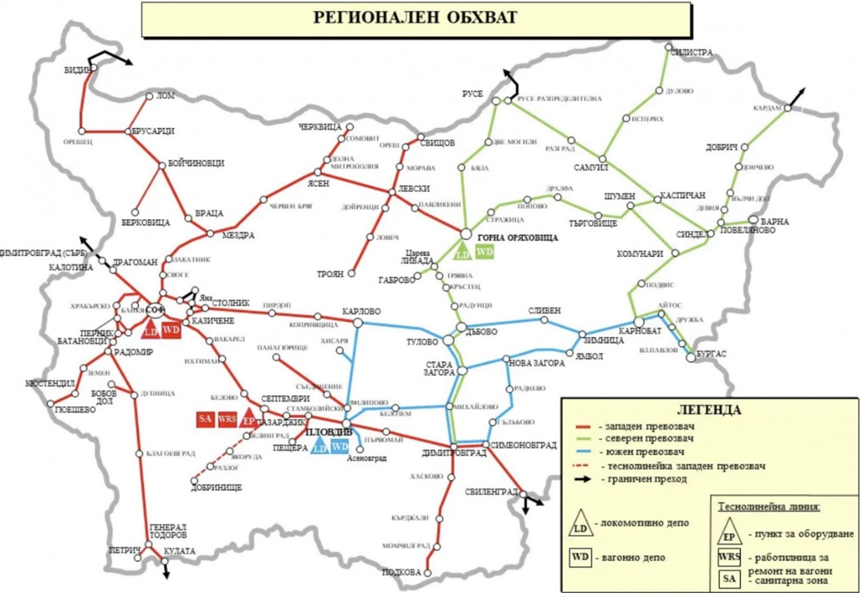
The public tender envisaged the provision
of passenger rail transportation services on existing railway routes in the
northern and southern regions, the winner was given the right to carry 25% of
the country's rail passenger traffic.
The Bulgarian Parliament, in parallel with
the liberalization of the passenger transport market, took an important step
and made amendments to the Law on Railway Transport. The legislation abolished
the right of the national monopolist to collect infrastructure fees, develop
train schedules, manage railway traffic, and exclusively implement applications
for railway capacity.
Naturally, in the event that Georgia adopts
a decision on the liberalization of the railway passenger transport market, the
country's legislative body will have to make similar amendments to the Georgian
Railway Code.
The Bulgarian Ministry of Transport
announced a tender for the selection of railway passenger transport operators
in August 2025. The contracts for both the northern and southern lots will be
for a period of 12 years, with the state providing both operators (state and
private) with a subsidy of €1.4 billion in exchange for unprofitable
operations.
The main question is whether the state will
allocate EU-subsidized passenger trains to the private operator.
The state will be involved in the
allocation of new rolling stock. In particular, the private operator will lease
new Škoda regional trains, which the Czech manufacturer will supply to the
Bulgarian Ministry of Transport. These trains (25 units) were purchased with
European subsidies.
The new trains will be allocated in
proportion to the volume of traffic on the transport service. After the
expiration of the contract, the passenger trains will be returned to the state
in good condition. Obviously, at the first stage, the private carrier will
simply use the trains leased from the state and will not purchase new ones.
The private company will have to fulfill
social obligations. In particular, the state will employ 800 employees from BDZ
Passenger Transportation, if they wish, at Ivkoni Express, maintaining their
existing working conditions.
According to the Bulgarian Ministry of
Transport, it is planned to increase the subsidy per train-kilometer by 50%,
from the current 6 euros to 9 euros, by 2027. This amount will cover not only
operating costs, but also investments in modernization, safety and improved
maintenance.
In conclusion, an analysis of the liberalization model of the railway passenger transport sector in Bulgaria, one of the poorest countries in the European Union, clearly demonstrates the need for changes in the action strategy and legislative level in the sector. The systematic renewal of Georgia's passenger transport will put the country in a position to share a similar process.
transcor.ge