News
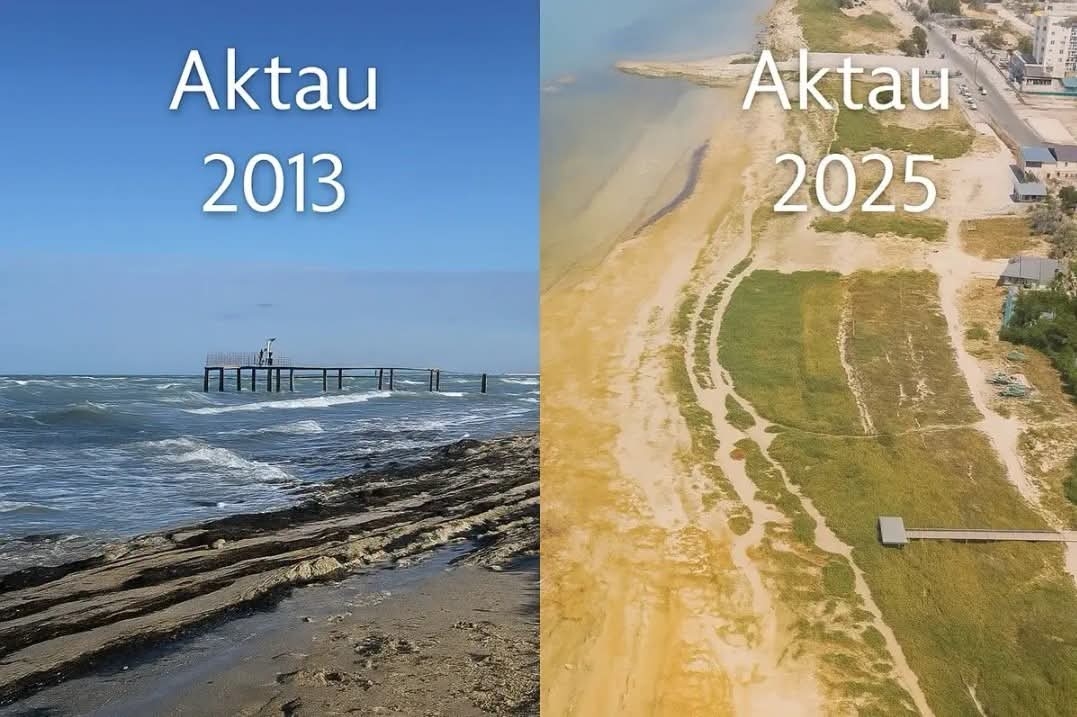
How does the decline in the Caspian Sea level affect the functioning of the Middle Corridor
2026-08-24
Scientists maintain that the decline in Caspian water levels
remains one of Eurasia's major environmental and geoeconomic challenges.
Studies confirm that the process of falling sea levels will
accelerate, impacting the energy, transport, and security sectors of the
Caspian littoral states.
How does the drop in Caspian Sea levels affect the
economies of the surrounding states, and what possibilities exist to mitigate
this decline?
Among the Caspian littoral states, Kazakhstan stands out as
being at the epicenter of the threat posed by falling sea levels. Modeling data
for the Caspian coastline indicates that 70% of the areas vulnerable to water
level decline are located in Kazakhstan.
Over the past three decades, the Caspian Sea's water level
has dropped by approximately two meters, and its surface area has shrunk by
15,000 square kilometers. This reduction is particularly noticeable in the
coastal bays of Kazakhstan. Climate change and the disruption of the annual
water inflow balance from the Volga River into the Caspian Sea are the primary
causes of the sea's receding levels. Notably, the Volga River accounts for 86%
of the water inflow into the Caspian Sea.
The continued decline of the Caspian Sea—particularly under
unstable scenarios—will negatively impact the economic interests of all Caspian
region states (Kazakhstan, Russia, Azerbaijan, and Turkmenistan), as well as
those of Turkey and the European Union.
The drop in sea level directly affects the region's economy,
specifically the transport, oil and gas, and fishing sectors.
The ports of Aktau, Baku, and Turkmenbashi are compelled to
regularly carry out dredging operations; this increases logistics costs and
complicates navigation safety, primarily impacting the cargo-carrying capacity
of vessels. According to data from the Port of Aktau, vessels currently arrive
partially unloaded: specifically, tankers carry up to 3.1 thousand tons, feeder
container ships up to 0.3 thousand tons, and grain carriers up to 1.2 thousand
tons.
According to the Ministry of Transport of Kazakhstan,
dredging operations recently completed at the Port of Kuryk have increased the
depth of the berths and the approach channel from 5.5 meters to 7–8 meters.
As for the Port of Aktau, the average depth is 4.5 meters,
whereas normal navigation requires 6.5–7 meters. Consequently, vessels can only
be loaded to 75% of their capacity.
Dredging operations in Aktau began in 2025 and are ongoing.
It is expected that once the work is completed, the vessels' full
cargo-carrying capacity will be utilized.
Experts point to two main reasons for the receding level of
the Caspian Sea: climate change and a reduction in the inflow from the Volga
River.
At present, it is difficult to make precise forecasts
regarding the future of the Caspian Sea. In recent years, most scientific
forecasts have been alarming, while the theories themselves differ radically
from one another.
There is a view that the sea could split into two parts due
to a catastrophic drop in water levels. At the same time, there are contrasting
forecasts suggesting that between 2030 and 2050, the sea level might begin to
rise and return to its previous boundaries.
It is precisely then that a substantive discussion regarding
the "breathing" of the Caspian Sea will be possible.
Although the Volga River is the primary source of inflow for
the Caspian Sea, issues of water resource management are becoming critical for
Kazakhstan's economy and ecology against the backdrop of the sea's rapidly
falling levels and mounting climate challenges.
Since the beginning of 2026, a water volume of 6 billion
cubic meters has been directed into the Caspian Sea basin; over the past two
and a half years, this figure has exceeded 35 billion cubic meters.
The most significant volume of water supplied to the Caspian
Sea was recorded in 2024. Specifically, as a result of anomalous flooding, an
additional 17 billion cubic meters of water—amounting to nearly half of the
total volume—flowed into the Caspian Sea.
To this end, water-saving technologies were implemented
across an additional 800 hectares in the Atyrau region, near the ports of Aktau
and Kuryk.
For Kazakhstan, the efficient and rational use of
water-saving technologies represents a strategic priority; the primary goal is
to reduce water losses, optimize consumption, and ensure sustainable management
amidst water scarcity.
For instance, state support measures implemented by
Kazakhstan in recent years have increased the rate of adoption of water-saving
irrigation technologies fivefold.
While the average annual rate of implementing such systems
stood at 30,000 hectares prior to 2024, this figure rose to 150,000 hectares
per year in 2024 and 2025.
Therefore, water-saving irrigation for agricultural lands
can be viewed as one of the tools for maintaining the water balance of the
Caspian Sea.
The implementation of provisions from the new Water Code,
adopted in 2025, is underway in Kazakhstan. The document envisages the
large-scale modernization of water usage practices within the country's
industrial enterprises.
To address issues concerning the Caspian Sea, the President of Kazakhstan called upon the international community—during the UN General Assembly session in September 2025—to take urgent measures to preserve the sea's water resources.
transcor.ge