News
Lack of investment is making the Poti Industrial Zone less attractive
2025-06-30
Today, four free industrial zones (FIZs)
are operating in Georgia – Poti, Kutaisi, Kutaisi Hualing and Tbilisi
Technology Park.
Based on proven experience around the
world, the main purpose of a free industrial zone located near a port in a
particular country is to supply cargo flows to the transport corridors passing
through it. It is for this purpose that the Poti Free Industrial Zone was
selected in 2009.
It is worth noting that, given its
infrastructural capabilities, the lack of investment in recent years has led to
the Poti FIZ losing its function of supplying cargo to the middle corridor,
which is reflected in the reduction of employment and the insignificant number
of companies located in free zones.
The Poti Free Industrial Zone covers an
area of 300 hectares, of which only a small part - a fifth - has been
developed.
For comparison, in the Aktau Free Economic
Zone in Kazakhstan, the operation of which was determined by law until 2028,
due to the growth of investments, by the decision of the President of
Kazakhstan, its operation with the status of a free economic zone was extended
until 2052, with the target indicator for 2052 providing for a total investment
of 1.2 billion dollars.
In terms of employment, if we consider all
four free industrial zones of Georgia, one medium-sized enterprise employs more
people than the businesses in all four industrial zones combined.
The Poti FEZ has been operating since 2009.
The zone is 75% owned by the Chinese energy company CEFC China Energy, which
has transferred the right to manage the share to Smart Capital Group since
2018.
The connectivity of the Middle Corridor and
the proximity to the Poti Port give the Poti FIZ an additional advantage in
terms of investment inflow.
One of the important infrastructural
problems of the Poti FIZ, which remains an unfulfilled promise from the state
to this day, is the connection to the Poti Port via a railway line through the
Poti FIZ.
The connection of the Poti Port with the
Poti Free Industrial Zone by rail is envisaged by the National Transport and
Logistics Strategy for 2023-2030, and the construction of the 1.8 km long
railway is the responsibility of the Georgian Railways and should be
implemented with its financial resources. The new railway section should
connect the Poti FIZ to the Poti Port.
Currently, cargo that ultimately has to be
transported to the port has to pass through the entire city, which is
associated with additional transport congestion for the city. The existence of
a railway section through the FIZ territory would completely eliminate the
city's congestion. In fact, it would be possible to use the industrial zone
territory as a transport corridor.
As a result, not only the industrial zone
but also other companies outside the zone, which currently have to transport
cargo to/from the port through the city, would find it easier to deliver/export
products from the port area using the new railway line.
According to the statement of the director
of the Poti FIZ in 2023 – “Connecting by rail is not a difficult project, it is
possible to arrange railway infrastructure on this section in six months” –
despite the promises made by the state, it has not been possible to implement
both the construction of the railway section and the implementation of the
project to develop the adjacent port in the northern direction.
The Poti FIZ is characterized by a lack of
investments and, accordingly, low employment. In particular, in recent years,
only about 500 jobs have been created in the Poti industrial zone, which is an
insignificant indicator for generating additional cargo through the middle
corridor.
As for large infrastructure projects in the
industrial zone, they are mostly only in the process of discussion and promise.
There are also projects that have been started and, for unknown reasons, are
still unfinished.
One of the large investment projects
announced in 2023 in the Poti FIZ with Uzbek investment was the construction of
a multifunctional warehouse terminal on a 29-hectare territory. The investment
cost of the project was 50 million GEL and envisaged the creation of up to 100
new jobs. To date, preliminary design studies are underway - in fact, the
implementation of a financially viable project is in an uncertain phase.
In 2024, the launch of a copper concentrate
terminal worth 5 million GEL was announced, which was to be implemented with
Georgian-European investment. This project is also still unfinished for unknown
reasons.
In the Poti industrial zone, in recent
years, only projects of low financial capacity have been implemented. For
example, with an investment of 0.4 million GEL, the Georgian company VG House
established a wooden cottage factory, where it employed only 15 people. Also,
Nuts Times built a pistachio processing factory, where it invested 0.5 million
GEL and employed about 20 employees.
A few examples are enough to clearly see
the trend of investment in the Poti Industrial Zone in recent years.
In contrast to the Poti Industrial Zone, a
boom in investment inflows is observed in the Aktau Port Special Free Economic
Zone in Kazakhstan.
By the decree of the President of
Kazakhstan in 2002, the Aktau Port Special Free Economic Zone was created on
2,000 hectares, the functioning of which was determined until 2028.
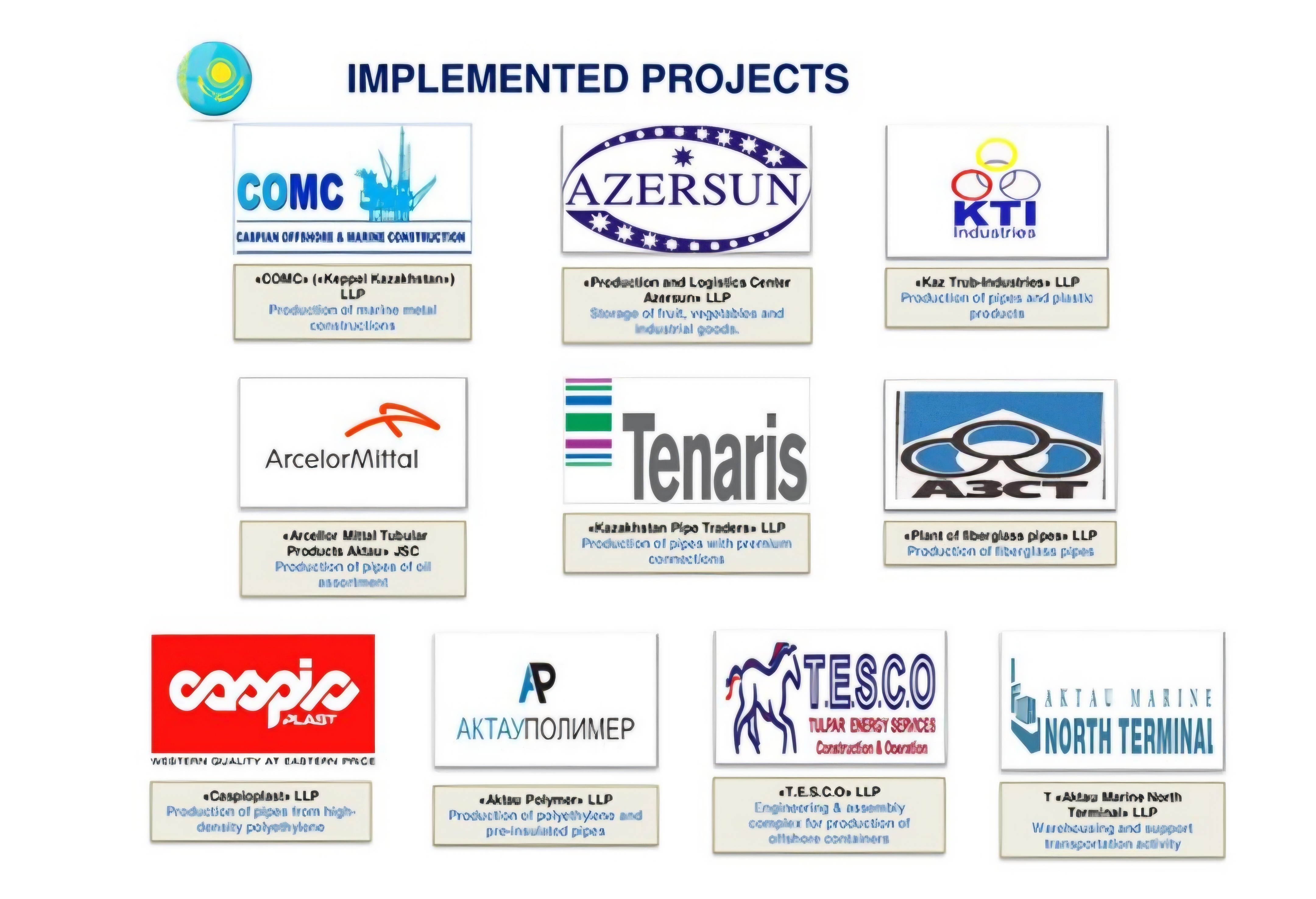
In recent years, many financially viable
industrial projects have been implemented in the Aktau Free Economic Zone. A
list of companies' specifications is presented in the photo to illustrate the
implemented projects. The main emphasis is on the development of local - Kazakh
industrial potential. Among the implemented projects, many local companies are
listed.
Given that the operation of the Aktau Port
Special Free Economic Zone was considered positive in terms of attracting
investments, the state decided at the end of 2024 to extend the term of the
free zone until the end of 2052.
It is important that the state has set
target indicators for the Aktau Free Economic Zone. In particular, the total
volume of investments should reach 1.0 billion dollars by 2047, and 1.2 billion
dollars by 2052.
The Aktau Free Zone is a clear example of
how effectively Kazakhstan uses its own infrastructure, both to attract
investments and to ensure cargo flows through the middle corridor.
Info: transcor.ge