News
Maritime Corridor Security and Georgia`s Strategic Future
2026-11-02
Today, the Black Sea is no longer merely a geographical
space for international trade. It has evolved into a critical arena for
regional security, geopolitical competition, and the resilience of
international transport systems. Military confrontations, the threat of attacks
on merchant vessels, the vulnerability of port infrastructure, and increasingly
complex maritime insurance conditions clearly underscore the vital importance
of secure maritime corridors.
In this context, the disruption of maritime routes is not
simply an opportunity for Georgia to attract additional transit cargo; it is a
strategic issue concerning the country’s economic and national development.
While Georgia has the potential to transform its geographical location into a
tangible logistical advantage, the mere existence of ports and a favorable
transit position will not be sufficient to achieve this.
International carriers select their routes based on factors
such as security, total shipping costs, insurance expenses, service quality,
and delivery timelines. Consequently, a disruption in any given maritime route
does not automatically lead to a diversion of cargo. Georgia’s competitiveness
will depend on its ability to offer the international market safe, rapid, and
predictable transport services.
Maritime Security and the Significance of the Middle
Corridor
The deterioration of security in the Black Sea impacts the
entire regional transport system. Georgia’s objective is to ensure the security
of its maritime domain, ports, and infrastructure, while maintaining confidence
within the international shipping community.
Maritime security encompasses the physical protection of
ports, the monitoring of vessel traffic, the proper functioning of navigational
systems, cybersecurity, pilotage and rescue services, and timely response to
maritime incidents. Furthermore, compliance with international insurance
requirements is crucial, as security risks directly affect the operational
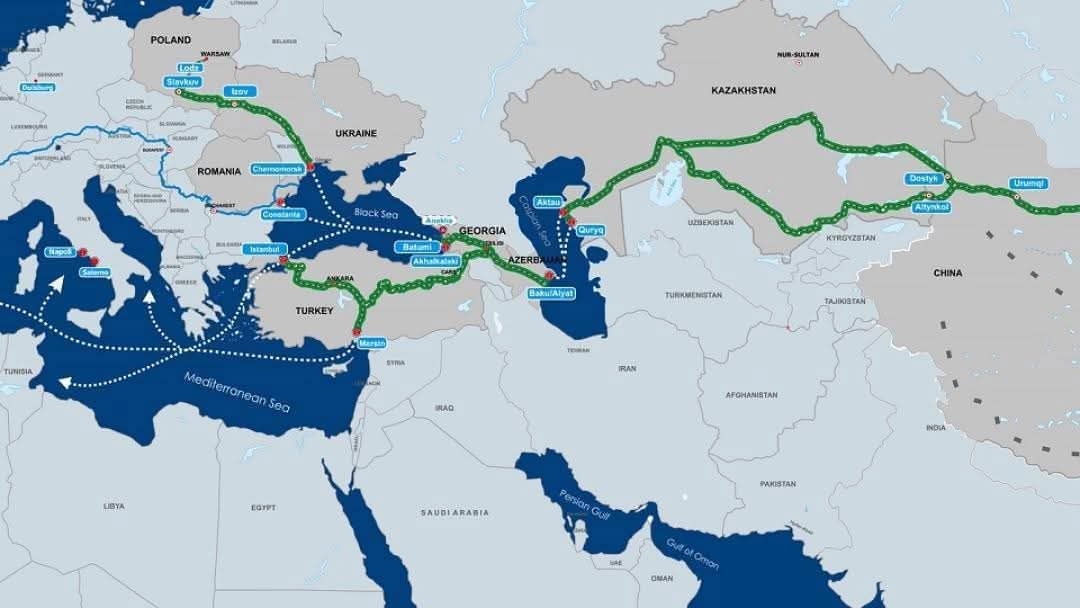
costs of vessels and the commercial terms of shipping. The Middle Corridor—an
interconnected transport system linking the Caspian and Black Seas—holds
particular significance. Its efficiency depends on the coordinated operation of
ports, railways, ferry services, and customs systems across Azerbaijan,
Kazakhstan, Georgia, and Turkey.
Therefore, Georgia’s success should be measured not merely
by the volume of cargo transiting its territory, but also by total transit
time, cost, security, and reliability.
Ports and Integrated Logistics Infrastructure
One of Georgia’s primary challenges is expanding the
capacity of its port and land-based infrastructure. Rising international demand
will only yield economic benefits if the country can efficiently handle the
additional cargo. Otherwise, there is an increased risk of port congestion,
railway delays, and rising service costs.
The ports of Poti, Batumi, Anaklia, Kulevi, and Supsa should be viewed as components of a unified national maritime and port system. Each of them should have a clearly defined, complementary function, which will enhance overall transport capacity.
The development of the Anaklia deep-sea port is of
particular strategic importance. It should enable Georgia to accommodate
high-capacity vessels, expand container shipping, and engage more actively in
international maritime networks.
However, the efficiency of the new port will depend on its
seamless integration with railways, road networks, customs infrastructure,
container terminals, and warehousing facilities. Furthermore, it is necessary
to develop logistics centers and temporary storage areas outside the port to
ensure that cargo handling is not hindered by constraints within the port
itself.
Georgia’s transport system must feature a network of
alternative routes to ensure service continuity in the event of disruptions to
any specific port, railway section, or shipping line.
Maritime Services and the Development of the Local
Economy
Georgia’s strategic goal should not be limited to the
physical movement of cargo. It is essential to develop maritime services and
the maritime industry, as these sectors generate greater additional economic
value than transit activities alone.
Pilotage, towage, ship agency services, technical
maintenance, ship repair, underwater operations, and rescue capabilities are
vital components of a modern maritime economy.
Georgia must possess its own qualified personnel and
technical capabilities to avoid becoming entirely dependent on foreign services
in these areas. This requires strengthening vocational education, training
seafarers, pilots, engineers, and logistics specialists, fostering the growth
of local companies, and implementing maritime technologies.
It is also important to develop ship repair, the
construction of specialized floating craft, the supply of maritime equipment,
and engineering services. These areas will create highly skilled jobs and
expand the participation of local businesses in the international maritime
economy.
Furthermore, it is essential to establish a unified digital
logistics environment that provides carriers with information regarding port
congestion, vessel arrivals, berth availability, customs procedures, and
land-based transport. The timeliness and accuracy of information are among the
key prerequisites for competitiveness in modern logistics.
Three Development Scenarios for Georgia
Capitalizing on the opportunities arising from shifts in
Black Sea security presents three primary development scenarios for Georgia.
The first is a temporary surge in transit activity.
Disruptions to maritime routes may drive increased demand
for Georgia’s ports and railways, leading to growth in cargo turnover,
transport-related revenues, and employment. However, if the generated revenue
is not reinvested into infrastructure modernization and the development of
local services, these gains will prove to be merely temporary once the crisis
subsides.
The second is a missed opportunity.
Should security in the Black Sea improve, international
carriers might restore their traditional routes. If, in the meantime, Georgia
fails to establish competitive tariffs, robust infrastructure, and reliable
services, a significant portion of the attracted cargo will shift to other
routes. The country would lose both revenue and the opportunity to strengthen
its position in the international market.
Third — transforming a temporary opportunity into a
long-term economic advantage.
This is the most desirable scenario for Georgia. Achieving
it entails developing infrastructure, building long-term relationships with
international carriers, establishing new maritime services, and cementing a
reputation as a reliable transport partner.
Under this model, cargo owners would choose the Georgian
route—not because of temporary disruptions elsewhere, but because of the
competitive pricing, security, speed, and predictability offered by the
Georgian transport system.
Conditions for Long-Term Competitiveness
To achieve this goal, a unified state policy is essential,
based on the following priorities:
Infrastructure: Modernization of existing ports,
increasing throughput capacity, and integrating Anaklia into the country’s
transport network.
Transport Coordination: Establishing an integrated
system encompassing ports, railways, and road transport.
Security: Port protection, vessel monitoring,
cybersecurity, and emergency response.
Maritime Industry: Development of pilotage services,
towage, ship repair, and technical maintenance.
Human Capital: Training of qualified specialists in
the maritime, engineering, and logistics sectors.
International Cooperation: Fostering long-term
commercial relationships with shipping lines, cargo owners, and logistics
companies; coordinating transport policies among Georgia, Azerbaijan,
Kazakhstan, and Turkey. Investments and Management: Public-Private
Partnerships, a stable investment environment, and strategic continuity.
Georgia’s transport policy should not depend solely on the
current geopolitical crisis. Infrastructure investments must remain
economically justified even under conditions of peaceful international trade.
According to World Bank estimates, targeted infrastructure
investments and operational reforms could significantly increase trade volumes
along the Middle Corridor by 2040, while also reducing transit times. While
this does not guarantee Georgia’s economic growth, it confirms that the
development of the corridor rests on an economic foundation independent of
geopolitical crises.
Economic Benefit — Beyond Cargo Turnover
Georgia’s economic outcomes should not be evaluated solely based on the volume of cargo transported. The total value of the cargo does not equate to the economic benefit for Georgia. The actual outcome is determined by locally generated value-added, service revenues, wages, taxes, and the economic return on investments.
If Georgia limits itself merely to the transit of cargo, its
economic benefits will be constrained. Conversely, if activities such as cargo
warehousing, consolidation, packaging, distribution, customs and technical
services, and ship repair are developed, significantly more economic value will
be retained within the country.
Strategic planning should encompass three horizons: in the
short term—attracting additional cargo and increasing operational revenues; in
the medium term—expanding infrastructure, securing long-term contracts, and
developing local services; and in the long term—establishing Georgia’s position
within the international logistics system and strengthening the maritime
industry.
Conclusion: From Geographical Location to Strategic
Advantage
The status of being a coastal nation does not, in itself,
create the economic and political capabilities of a maritime state. This
requires modern infrastructure, professional expertise, an effective security
system, international partnerships, and a consistent state policy.
Georgia possesses significant geographical assets: a Black
Sea coastline, operational ports, a railway network, international transport
connections, and the prospect of developing the Anaklia deep-water port.
However, these opportunities can only be transformed into a genuine national
advantage if integrated into a unified system.
The country’s objective should not be limited to merely
handling cargo diverted from other routes during times of crisis. Instead,
Georgia must develop a maritime and logistics system that the international
market trusts during periods of stability and relies upon during times of
crisis.
Disruptions to Black Sea maritime corridors could become a
historic opportunity for Georgia—provided the country leverages them to drive a
systemic transformation of its ports, railways, logistics infrastructure, and
maritime industry.
The country’s mission extends beyond the simple transit
of cargo. Its goal is to create a maritime transport environment where safety,
speed, reliability, professionalism, and economic efficiency converge into a
unified strategic advantage.
A country that is needed only during times of crisis
gains only temporary benefit. A country that remains essential even in the
absence of a crisis possesses a strategic advantage.
Georgia has access to the sea. Now, this geographical reality must be transformed into the economic strength of a maritime state, international trust, and a long-term national advantage.
Sea Pilot